

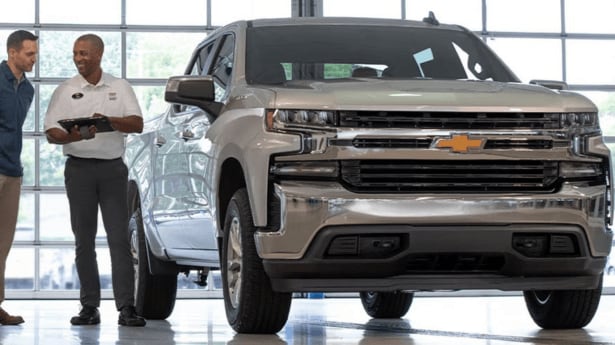
Yes, August is one of the single best months to buy a new vehicle because auto manufacturers transition to incoming model years during late summer, triggering current manufacturer incentives and financing options, subject to availability. Shoppers who buy in August can select from a strong range of current 2026 inventory before remaining stock thins out in the fall.
Late summer creates an ideal convergence where automakers begin shipping next-year inventory while current-year models remain fully stocked on dealer lots. Industry tracking shows national sales volume increases about 3% to 4% year-over-year in August as buyers take advantage of factory incentives on high-demand trucks and crossovers. Securing a vehicle before September prevents compromise on cab styles, bed lengths, or interior packages.
For drivers navigating the rolling hills and agricultural back roads around Millersburg, a practical truck like the 2026 Chevrolet Silverado 1500 offers a 9,000-lb towing capacity and a powerful 2.7L engine paired with a Hydra-Matic transmission. Shopping in late summer ensures access to these capable configurations while maximum factory clearing incentives remain active.
To explore options before visiting, buyers can browse our new vehicle inventory online or prequalify for financing online to review personalized loan terms. To speak directly with our team, give us a quick call at (330) 667-0245 or visit our showroom location on State Route 83.
Why Do Automakers Transition Model Years in Late Summer?
Automakers release new model year vehicles in late summer and early fall to align assembly plant retooling schedules, satisfy back-to-school consumer demand, and reset retail momentum ahead of the fourth quarter. Annual factory shutdowns typically occur for one to two weeks in mid-summer, clearing production lines for incoming builds while creating urgency to move remaining lot inventory.
This production rhythm dates back to traditional manufacturing schedules, where assembly plants paused in July or August to update machinery, recalibrate tooling, and install updated software for upcoming vehicle builds. Federal guidelines permit automakers to label a vehicle for the next model year as early as January 2 of the preceding calendar year, but industry practice concentrates new vehicle launches between August and October.
This timing produces a distinct financial advantage for buyers. Incoming shipments increase available options across showrooms, while the holding costs of maintaining existing inventory motivate dealerships to offer competitive pricing on outgoing 2026 models. Buyers seeking well-proven engineering without paying top dollar for a new release year find that outgoing models deliver maximum overall value.
For shoppers considering well-maintained pre-owned options alongside new models, reviewing our selection of pre-owned vehicles reveals additional choices that fit various family budgets and travel requirements.
When Do August Discounts and Clearance Rebates Typically Peak?
August car discounts typically start appearing during the second week of the month and reach peak strength heading into Labor Day sales events. Factory cash-back rebates, promotional APR offers, and dealer clearance cash build continuously through late August as inventory managers prepare for incoming shipments.
Discounting momentum follows inventory turnover pressure. Early August begins with standard monthly promotions, but as incoming shipments lock into transit status, automakers introduce higher factory-to-dealer cash allowances. These programs allow dealerships to provide competitive pricing on volume crossovers like the 2026 Chevrolet Equinox, which features an efficient 1.5L engine paired with a CVT and EPA estimates of 26 city / 29 hwy MPG.
Labor Day weekend marks the culmination of late-summer clearance initiatives. During this window, manufacturer incentives frequently bundle customer rebates ranging from $1,000 to $4,000 with reduced APR financing options between 0% and 2.9% for qualified buyers. Stacking these offers helps buyers reduce both the net purchase price and total interest expense over the life of the loan.
For commuters traveling daily along the Towpath corridor in Massillon, upgrading to a modern crossover with Automatic Emergency Braking and available Super Cruise hands-free driving technology provides significant daily comfort. Buyers can evaluate your trade-in online before shopping to establish a clear baseline for current vehicle equity.
Should You Focus on Out-of-Door Price or Monthly Payment on August Offers?
Buyers should always focus on negotiating the total out-of-the-door price first, because concentrating solely on monthly payments can conceal extended loan terms, higher overall interest charges, and unnecessary add-ons. Negotiating the final vehicle price before discussing monthly financing terms ensures complete financial transparency.
A total out-of-the-door price includes the agreed vehicle sale price, manufacturer rebates, documentation fees, state sales taxes, and registration costs. Locking in this bottom-line figure enables buyers to compare discounts accurately across different vehicle trims. For example, the 2026 Chevrolet Silverado 1500 Custom 4X4 Crew Cab Short Box carries a base MSRP of $48,100 with a $2,595 destination charge, while the Work Truck 1WT Regular Cab Long Box carries a base MSRP of $37,100 with a $2,595 destination charge.
Focusing exclusively on monthly payments allows financing terms to be stretched from 60 months out to 72 or 84 months. While an 84-month loan lowers the monthly payment figure on paper, it substantially increases total interest costs over time. Industry loan studies show that unmonitored dealership financing arrangements can carry interest rate markups averaging over one percentage point above wholesale rates, adding more than $1,100 in excess interest on a typical $40,000 loan.
Structuring a transparent purchase involves three straightforward steps: establishing the vehicle's final out-of-the-door price, applying trade-in equity, and choosing a sensible financing term. Arriving with a pre-approved auto loan from a bank or credit union provides leverage, allowing buyers to choose whichever financing source yields the lowest annual percentage rate.
Should You Buy a Current 2026 Model Year or Wait for Future Arrivals?
Buying a current 2026 model year vehicle in August is generally the smarter financial decision unless an upcoming model introduces a major redesign or critical mechanical overhaul that directly impacts your needs. Current-year models offer proven engineering, substantial clearance rebates, and immediate availability without the price increases typical of incoming releases.
When walk-around shoppers examine outgoing 2026 trucks next to preview details for future model years, they often ask if waiting brings meaningful mechanical changes or just minor cosmetic updates. In most cases, mid-cycle carryover models maintain identical powertrains and chassis structures. The 2026 Chevrolet Silverado 1500 provides dependable engine options, including the 2.7L engine producing 310 hp and 430 lb-ft of torque, a 5.3L V8 delivering 355 hp and 383 lb-ft of torque, and a 3.0L Duramax turbo-diesel generating 305 hp and 495 lb-ft of torque.
Purchasing an established 2026 trim level avoids the initial sticker price increases that automakers apply to new model years. Historical sales data indicates that incoming model year vehicles arrive with reduced factory rebates and higher MSRPs. Furthermore, factory-backed bumper-to-bumper and powertrain warranties remain identical whether choosing a current 2026 model or waiting for a later shipment.
Families seeking spacious multi-row utility will find that the 2026 Chevrolet Traverse provides a 7-passenger layout, a 2.5L engine linked to an 8-speed automatic transmission, and 20 city / 24 hwy MPG. Buying in August secures these features at clear clearance value before new arrivals reset baseline pricing.
Frequently Asked Questions About Shopping for a Car in August
Q: Are Labor Day sales events in late August worth waiting for?
Labor Day sales events are among the best times of the year to buy because manufacturers align aggressive cash-back rebates and promotional interest rates to clear outgoing inventory. Waiting for late August or early September enables buyers to combine holiday factory incentives with dealer clearance cash, driving down total vehicle acquisition costs.
Q: How do factory clearance rebates affect my existing vehicle's trade-in value?
Factory clearance rebates directly reduce the purchase price of the new vehicle without reducing your trade-in's market value. Strong late-summer demand for pre-owned vehicles keeps trade-in appraisals competitive, allowing buyers to apply maximum equity toward a discounted current-year model.
Q: Will waiting until December yield significantly deeper discounts than buying in August?
While December offers strong year-end sales incentives, waiting four extra months severely limits available inventory choices regarding trim levels, exterior colors, and options packages. Shopping in August strikes the ideal balance between deep clearance discounts and a robust selection of current-year configurations on dealer lots.
Q: Can I combine August manufacturer cash rebates with special APR financing offers?
In many cases, automakers require buyers to choose between standalone customer cash rebates or promotional low-APR financing rates. Evaluating both options with a finance manager will clarify whether taking the cash discount or securing a lower interest rate yields greater overall savings based on your loan term and down payment.
Q: What documentation should I bring to streamline my August purchase?
To ensure a fast transaction, bring a valid driver's license, current auto insurance card, vehicle registration for your trade-in, and recent pay stubs if requested by lenders. Having these documents ready eliminates processing delays and allows you to finalize your purchase smoothly.
*Prices and MSRP referenced in this article are estimates for informational purposes only and do not constitute an offer to sell. See dealer for complete details. *Fuel economy estimates shown may differ from official EPA ratings and should not be relied upon as a guarantee of actual vehicle performance.